

Why Traditional Usability Testing Is Too Slow for Modern Product Teams
Modern product teams ship faster than traditional usability testing can keep up. The result is delayed feedback, missed context, and decisions made before research arrives.
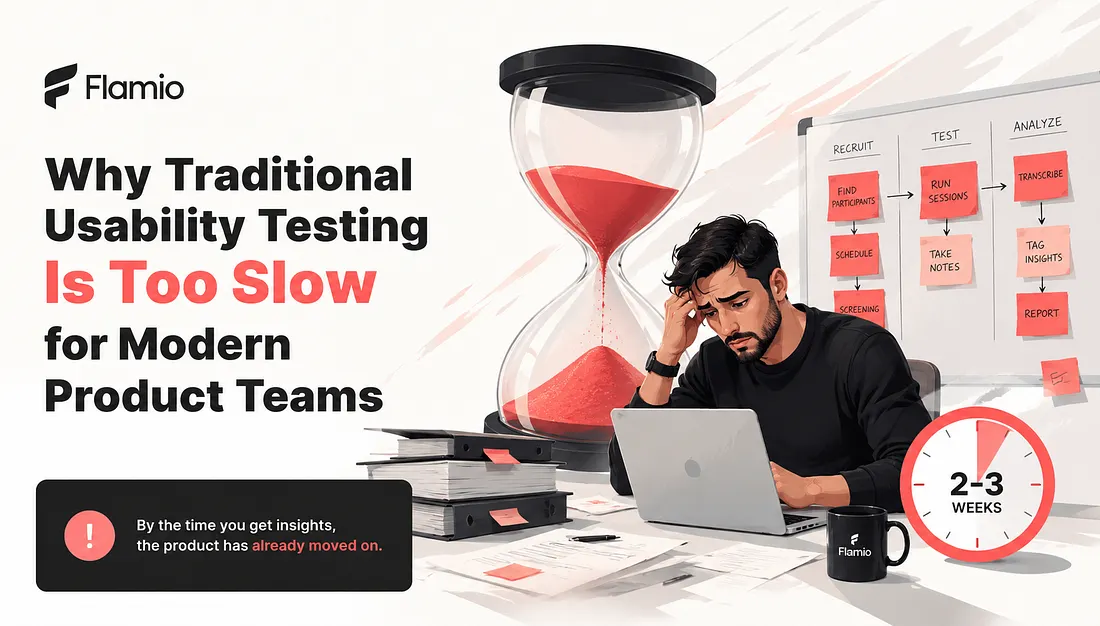
Most product teams do not fail because they ignore users. They fail because user feedback arrives too late. For many years, usability testing was treated as a serious, structured, and often relatively slow research activity. A team would define the research goals, recruit participants, schedule sessions, observe users, collect notes, review recordings, synthesize findings, write a report, and then present recommendations to stakeholders. In many companies, this process still works. It gives teams a structured way to understand how people interact with a product and where the experience breaks down. The problem is that modern product development no longer moves at the same speed.
Modern product development no longer moves at the same speed
Today, product teams ship faster than ever. Startups release MVPs in weeks, not quarters. Product managers run experiments continuously. Designers update flows based on business goals, analytics, customer requests, and competitive pressure. A feature can change three times before a traditional usability study is fully analyzed. This creates a growing mismatch between how product teams build and how usability testing is often conducted. The need for user feedback has not disappeared. In fact, it has become more important. But the classic process is often too slow, too heavy, and too disconnected from the pace of modern product decisions. Traditional usability testing is not broken. It is still valuable. But for many product teams, especially startups, it is no longer enough on its own.
The old usability testing model was built for a slower product cycle
Traditional usability testing made sense in an environment where product decisions were slower and releases were less frequent. If a team spent several weeks preparing a test, running sessions, analyzing behavior, and writing a detailed report, that timeline could still fit into the broader product cycle. That is not always true anymore. Modern product teams often work in short iterations. A startup may test positioning on Monday, change onboarding on Wednesday, and ship a new pricing page by Friday. In that context, waiting two or three weeks for a usability report can make the research feel outdated before it reaches the team. This is especially painful for early-stage companies. Startups are not usually trying to validate one polished product once every few months. They are trying to survive uncertainty. They need to understand whether users can complete key actions, whether the value proposition is clear, whether the onboarding flow makes sense, and whether the product creates enough trust to move people forward. These questions are not abstract. They affect conversion, retention, activation, and revenue. But if the feedback loop is too slow, teams often make decisions based on assumptions instead.
The real cost of usability testing is not only money
When people say usability testing is expensive, they usually think about recruitment costs, research tools, incentives, or agency fees. These costs matter, but for many product teams, the biggest cost is attention. Someone has to plan the test. Someone has to write the tasks. Someone has to recruit or invite participants. Someone has to observe sessions or review recordings. Someone has to identify patterns and separate real usability problems from random behavior. Someone has to turn findings into priorities that the team can actually act on. This creates a hidden operational burden. A product team may collect five, ten, or twenty user sessions, but recordings do not automatically become insight. A recording shows what happened, but someone still has to understand why it happened and whether it matters. A user may pause because they are confused, distracted, cautious, or simply reading. A dead click may signal a broken expectation, or it may be an accidental click. A user may take a different path and still complete the task successfully. This is where many teams slow down. They do not lack data. They lack the time and structure to interpret it quickly. The result is familiar: user testing recordings sit unwatched, insights arrive too late, and product decisions continue without enough behavioral evidence.
Startups need faster answers to smaller UX questions
One of the reasons traditional usability testing feels slow is that it often tries to answer too much at once. A single study may cover multiple flows, several research questions, and a broad set of usability concerns. That approach can be useful for major redesigns or strategic research, but it is often too heavy for everyday product decisions. Startups usually need faster answers to smaller questions. Can users understand the signup flow? Can they find the main action on the dashboard? Do they notice the pricing toggle? Does the onboarding step explain enough? Where do users hesitate before completing the task? Which part of the flow creates unnecessary friction? These questions do not always require a long moderated session. Sometimes, a short, focused test around one user flow is enough to reveal the most important issue. This is an important shift. Instead of treating usability testing as a large research event, modern teams can treat it as a continuous feedback mechanism. Small tests can happen more frequently. They can focus on specific flows. They can support product decisions while those decisions are still being made. For startup UX, this matters a lot. Early teams do not have the luxury of waiting for perfect research conditions. They need directional clarity, fast.
The problem with raw user testing data
Many user testing tools help teams collect recordings, clicks, heatmaps, task completions, and survey responses. This is useful, but collection is only the first step. The harder question is interpretation. A dashboard may show that users dropped off at step three, but it may not explain why. A heatmap may show where people clicked, but it may not tell the team whether the layout was misleading. A session recording may show confusion, but only if someone takes the time to watch it carefully. This is why raw user testing data often creates another problem: analysis debt. The team has information, but the information still needs to be processed. The more sessions they collect, the heavier the analysis becomes. The more product experiments they run, the more difficult it becomes to keep up. This is one of the biggest weaknesses of the traditional usability testing process in modern teams. It assumes that humans will have enough time to manually review, interpret, and synthesize every important behavior. In reality, product teams are already overloaded. They do not need more unprocessed data. They need faster paths from user behavior to product insight.
User behavior is often more honest than user opinion
Another reason usability testing needs to evolve is that what users say and what users do are not always the same. A user may say that a flow is clear while still hesitating at the key step. They may say they understand the page while scrolling up and down repeatedly. They may say the product feels simple while missing the main call to action. This does not mean users are dishonest. It means people are not always able to accurately explain their own behavior. Behavioral signals can reveal friction that users may not verbalize. Hesitation, repeated clicks, unnecessary backtracking, rage clicks, missed CTAs, scrolling patterns, and task abandonment can all indicate problems in the experience. The challenge is that behavioral signals require context. A pause is not automatically a problem. A click is not automatically a mistake. A different path is not automatically a failed task. The team needs to understand the user’s goal, the expected flow, the product context, and the pattern across multiple sessions. This is where traditional manual analysis becomes slow. The researcher or designer has to connect the dots between behavior, task, interface, and product intent. Modern UX research needs better ways to do this faster.
AI can help, but only if it understands context
AI is often presented as a shortcut for everything, which is usually where the conversation becomes shallow. UX research is not just about summarizing text or generating generic recommendations. Good UX analysis depends on context. A checkout flow, a SaaS dashboard, a landing page, and an enterprise admin panel all have different expectations. The same behavior can mean different things depending on the product. A user pausing on a pricing page may be comparing plans. A user pausing inside a setup flow may be confused. A user clicking on a card may expect it to be interactive, or they may simply be exploring. This is why AI in usability testing should not be treated as a magic replacement for researchers. The real value is not “AI writes a report.” The value is helping teams detect repeated behavioral patterns, organize evidence, and surface likely friction points faster. For example, AI can help identify when several users struggle with the same step in a flow. It can highlight repeated hesitation, dead clicks, missed actions, and task deviations. It can compare user behavior against an intended happy path and show where the experience breaks down. This does not remove the need for human judgment. It reduces the amount of manual work required to reach that judgment. That difference matters.
What modern usability testing should look like
Modern usability testing should be lighter, faster, and more continuous. Instead of relying only on large research cycles, product teams should be able to test important flows regularly. A more modern process might look like this: the team defines one critical user flow. They record the intended happy path. They send a short test to several users. Each user completes a focused task in one or two minutes. The system captures behavioral signals. Then the team receives a structured summary of where users struggled, what patterns appeared, and which issues are worth reviewing. This does not replace deep UX research. It creates a faster layer for everyday product decisions. There will always be a place for moderated interviews, discovery research, ethnographic studies, and complex qualitative analysis. But not every product question needs that level of depth. Sometimes the team simply needs to understand whether users can complete a specific task without friction. For many startups, that faster layer can make usability testing practical again.
The future of usability testing is continuous UX learning
The future of usability testing is not about abandoning traditional research. It is about matching research methods to the speed of product development. Deep research is still essential for strategic questions. But for fast product iteration, teams need faster feedback loops. They need to test smaller flows more often. They need to understand user behavior without spending hours manually reviewing every session. They need insights that arrive while the product decision is still relevant. This is the shift we are seeing in modern UX research: from occasional usability testing to continuous UX learning. The best product teams will not be the ones that run one big usability study and produce the longest report. They will be the ones that build a habit of learning from users continuously. They will identify friction early, fix it faster, and make product decisions with more confidence.
How Flamio fits into this shift
At Flamio, we are building around this idea. Flamio helps product teams turn short user tests and behavioral signals into actionable UX insights. The goal is not to replace researchers or designers. The goal is to help teams understand where users struggle faster, especially when they are testing specific flows and need clear answers without hours of manual session review. Because modern product teams do not need more noise. They need faster clarity. And usability testing has to evolve to provide it.
Takeaway
Traditional usability testing is not broken because the method lacks value. It is too slow for teams that need continuous, evidence-based product decisions. Modern teams need faster clarity, not more noise.
More Flamio notes
The End of Watching Session Replays by Hand
Session replay gave teams visibility, but the next product advantage is finding the moments that deserve attention without watching hours of playback.
AI insightsThe Best AI UX Research Will Start With Behaviour, Not Prompts
AI UX research becomes more useful when it starts from real user behavior, intended journeys, and friction patterns rather than isolated interface prompts.
Founder notesBefore You Hire a UX Researcher, Test One Flow
Early teams can learn a surprising amount by testing one critical flow before building a large research process or hiring a dedicated researcher.