

The next generation of UX Tools will understand behaviour, not just track events
The next generation of UX tools will move beyond event tracking, helping teams interpret behaviour, understand intent, and turn interaction data into product insight.
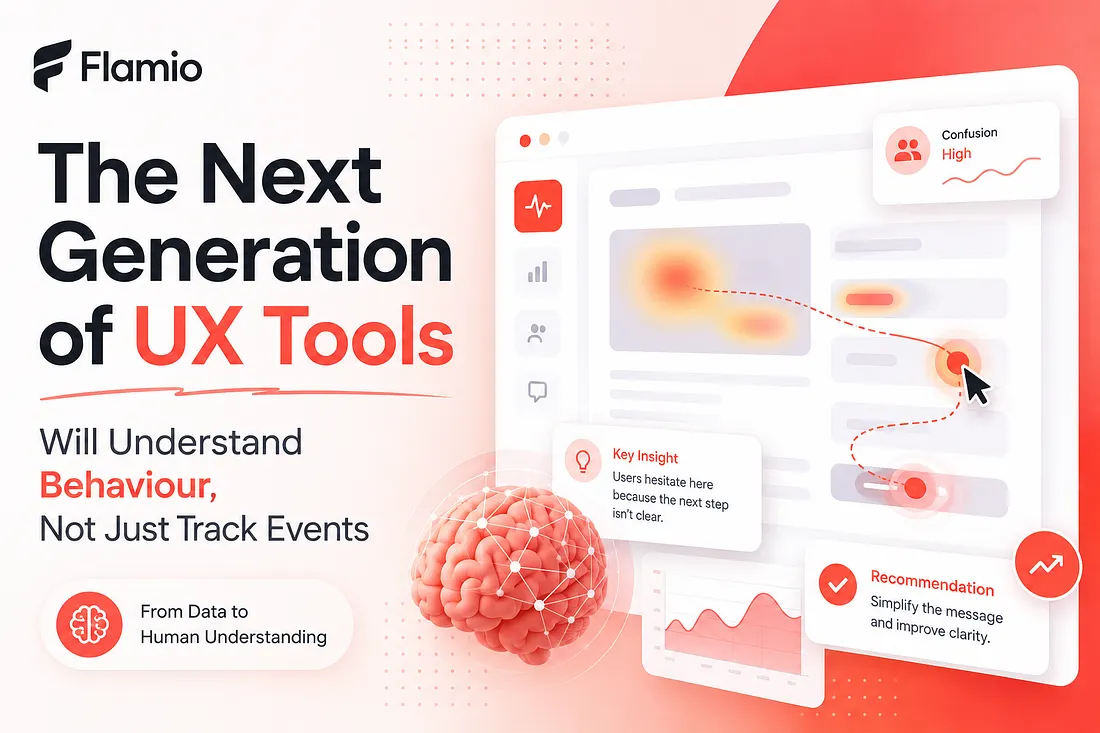
For years, digital product teams have been obsessed with tracking. Clicks, page views, scroll depth, drop-off points, conversion rates, time on page, funnel steps, feature usage, session recordings. The modern product team can measure almost everything a user does inside an interface. And yet, many teams still struggle with the same question: why did the user behave that way? This is the gap that traditional UX tools and product analytics platforms have never fully solved. They are very good at collecting events. They can show where users clicked, where they dropped, how long they stayed, and which path they followed. But they usually stop at observation. They tell you what happened. But they rarely explain what it means. That difference will define the next generation of UX tools. The future will not belong to tools that simply track more events. It will belong to tools that understand behaviour, interpret user intent, and turn raw interaction data into clear product insight.
Event tracking was useful, but it is never a whole story
Event-based analytics changed the way teams build products. Instead of guessing whether users were signing up, activating, exploring, or converting, teams could finally measure behaviour at scale. Product analytics helped companies understand funnels, measure retention, compare cohorts, and identify where users were leaving. This was a huge step forward. But event tracking has a natural limitation. It reduces human behaviour into isolated actions. A click becomes an event. A page visit becomes an event. A button tap becomes an event. A form submission becomes an event. The problem is that users do not experience products as a sequence of database entries. They experience products as flows, decisions, doubts, frustrations, expectations, and moments of clarity or confusion. A user who clicks three times on the same element may be curious, confused, impatient, or blocked. A user who pauses before clicking "Continue" may be reading, hesitating, losing trust, or trying to understand the consequence of the next step. A user who abandons onboarding may not simply be "inactive." They may have hit cognitive overload. Traditional analytics can capture the action. It cannot always capture the reason behind the action.
Behaviour is more than movement
User behaviour is not just about where the cursor goes or which button gets clicked. It includes hesitation, repeated attempts, backtracking, rage clicks, dead clicks, pauses, misclicks, scanning patterns, abandoned paths, and moments where users seem to search for something that the interface fails to provide. These small behavioural signals are often more revealing than high-level metrics. A funnel report might show that 42 percent of users drop off during onboarding. That is useful, but incomplete. A behavioural view can reveal that users are dropping because they do not understand a pricing question, cannot find a required field, distrust a permission request, or misinterpret a call-to-action. The metric shows the wound. Behaviour shows how it happened. This is why behavioural analytics is becoming more important for product teams. It gives context to numbers. It helps teams move from "users are leaving here" to "users are leaving here because this step creates confusion." And that shift matters because product teams do not need more dashboards. They need better decisions.
The problem with more data
Most teams already have too much data. They have analytics dashboards, heatmaps, recordings, conversion reports, support tickets, feedback forms, surveys, interviews, and internal assumptions. The issue is not the lack of information. The issue is the lack of interpretation. A founder may know that users are not completing signup. A product manager may know that activation is weak. A designer may know that a flow "feels off." But knowing that something is wrong is only the beginning. The harder part is understanding why it is wrong, what should be changed, and which issue matters most. This is where many UX workflows slow down. Someone needs to watch recordings. Someone needs to tag patterns. Someone needs to compare sessions. Someone needs to translate observed friction into product recommendations. Someone needs to decide whether the problem is copy, layout, hierarchy, timing, expectation, trust, or usability. That work is valuable, but it is also slow. For early-stage startups, this delay can be brutal. Every week spent guessing means another week of lost users, weak activation, and unclear product direction. For growing product teams, the problem is different but just as serious. They may have the tools and the traffic, but not enough time to turn behaviour into insight. The future of AI UX tools will be shaped by this exact pain.
From tracking events to interpreting intent
The next generation of UX tools will not stop at asking, "What did the user do?" They will ask better questions. What was the user trying to do? Where did the user hesitate? Which part of the interface created friction? What pattern appears across multiple sessions? Which behaviour suggests confusion rather than normal exploration? What should the product team improve first? This is the difference between analytics and understanding. A traditional product analytics tool might tell you that users clicked a dropdown five times. A behaviour-aware UX tool should help explain whether the dropdown was unclear, whether the available options were confusing, whether users expected a different interaction, or whether the dropdown blocked progress in the flow. A traditional dashboard might show that users spent two minutes on a page. A smarter system should help interpret whether that time reflects engagement, confusion, comparison, uncertainty, or cognitive load. This is not just a better version of analytics. It is a different category of product intelligence.
Why AI changes the role of UX Tools
AI will not make UX research disappear. It will not replace the need for product thinking, design judgment, customer conversations, or human interpretation. But it can remove a lot of the slowest work around behavioural analysis. AI can help review sessions faster. It can detect repeated patterns. It can summarize friction. It can connect signals across different users. It can highlight moments where users hesitate, repeat actions, or fail to complete a step. It can turn a set of recordings into a clearer explanation of what is going wrong. That is where AI UX tools become especially powerful. The value is not simply automation. The value is faster learning. When product teams can understand user behaviour faster, they can make better decisions earlier. They can fix unclear flows before they damage conversion. They can validate assumptions before building too much. They can spot friction before it becomes product debt. In other words, the future of UX tools is not more tracking. It is faster interpretation.
Behavioural insight will become a product advantage
The teams that understand users faster will move faster. This is especially true in startups, where product decisions are often made under pressure. Founders need to know why users are not converting. Designers need evidence for their recommendations. Product managers need to prioritize changes with limited resources. In that environment, user behaviour insights become a competitive advantage. A team that only sees numbers may spend weeks debating what caused a drop-off. A team that understands behaviour can see the friction more clearly and act sooner. This does not mean every decision becomes obvious. Product work will always involve uncertainty. But behaviour-aware tools can reduce the fog. They can help teams move from opinion-based decisions to evidence-based iteration. That is the real promise of next-generation UX tools. They will not just report activity. They will help teams understand the human experience behind that activity.
Interfaces should learn from the user
The bigger shift is even more interesting. Today, most interfaces are static. They show the same structure to users and expect users to figure things out. If people struggle, the team might discover the issue later through analytics, feedback, or research. But the long-term future points toward adaptive interfaces. Interfaces will become better at recognizing confusion, hesitation, friction, and intent. They will not only display information. They will learn from how people interact with them. This does not mean interfaces should become intrusive or manipulative. It means products should become more responsive to human behaviour. A well-designed system should understand when users are stuck, when instructions are unclear, when the flow is too heavy, or when the next step needs more context. That is where UX tools, behavioural analytics, AI UX tools, and product analytics begin to merge into something more powerful: user understanding infrastructure. The goal is no longer to collect every possible event. The goal is to make interfaces more aware of the people using them.
Building an intelligence layer for UX decisions
The core problem is simple: most UX tools show what users did, but product teams still have to spend too much time figuring out what it means. That creates a gap between data and action. Teams collect clicks, recordings, and drop-off points, but they still need to manually identify friction, interpret behaviour, and decide what to improve next. For startups and small product teams, this gap slows down iteration exactly when speed matters most. Flamio is built around a different idea. It is not positioned as another UX analytics dashboard, session replay tool, or testing platform. Its broader vision is to become an intelligence layer between digital interfaces and human behaviour, helping products understand user intent, hesitation, confusion, friction, cognitive overload, and behavioural patterns automatically. In practical terms, Flamio works as an AI UX research assistant that watches user behaviour, detects friction, and turns recordings into clear product decisions. Instead of only showing what happened, Flamio aims to explain what went wrong, why it matters, and what the team should improve next. That is why Flamio fits naturally into the future of UX tools. The next generation will not be defined by who tracks the most events. It will be defined by who helps teams understand behaviour faster, learn from users more clearly, and build interfaces that adapt to humans instead of forcing humans to adapt to interfaces.
Takeaway
The next generation of UX tools will be defined by how well they help teams understand behaviour, not by how many events they can track.
More Flamio notes
The End of Watching Session Replays by Hand
Session replay gave teams visibility, but the next product advantage is finding the moments that deserve attention without watching hours of playback.
AI insightsThe Best AI UX Research Will Start With Behaviour, Not Prompts
AI UX research becomes more useful when it starts from real user behavior, intended journeys, and friction patterns rather than isolated interface prompts.
Founder notesBefore You Hire a UX Researcher, Test One Flow
Early teams can learn a surprising amount by testing one critical flow before building a large research process or hiring a dedicated researcher.