

Session recordings vs Heatmaps vs User testing: What product teams actually need
Session recordings, heatmaps, and user testing each reveal a different layer of user behavior. The real value comes from matching the method to the product question.
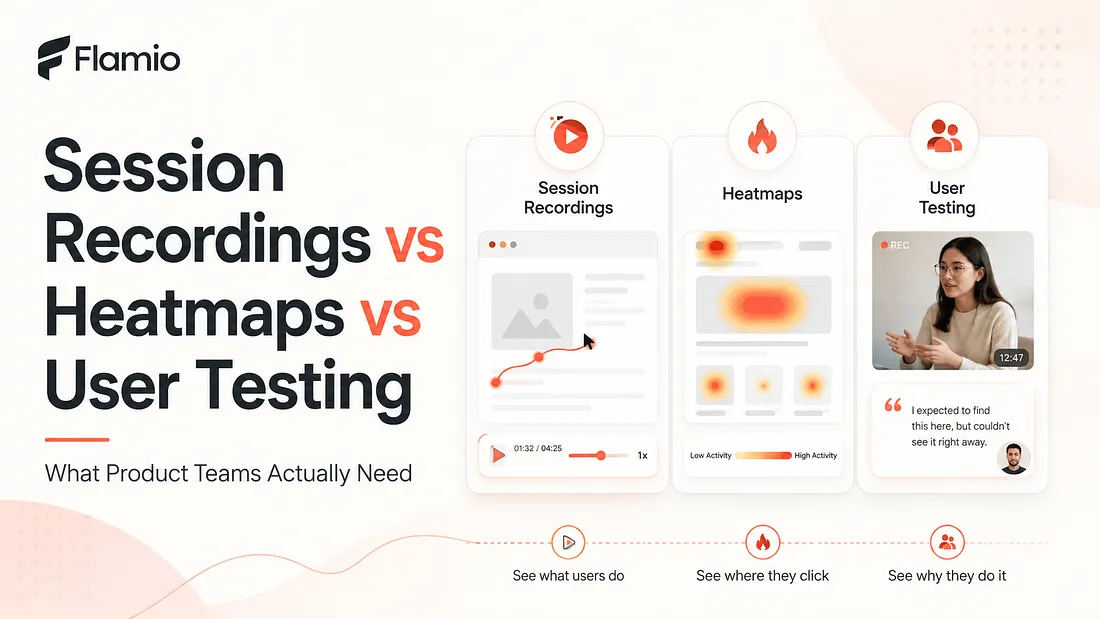
Most product teams do not lack data. They lack clarity. A typical team can look at conversion rates, funnel drop-offs, session recordings, heatmaps, survey answers, support tickets, and user testing notes. The problem is not that there is nothing to analyze. The problem is that every method shows a different version of the truth. Session recordings show what happened. Heatmaps show where attention and interaction concentrate. User testing helps uncover what people think, expect, misunderstand, or struggle to explain. None of these methods is "better" by default. Each one is useful only when it matches the question the team is trying to answer. That is where many product teams get stuck. They pick a UX analytics method before defining the problem. Then they collect more evidence, create more dashboards, watch more clips, and still end up asking the same question: what should we actually change?
Session recordings show behaviour in context
Session recordings are one of the most useful tools for understanding user behaviour because they preserve the flow. Instead of looking at isolated numbers, teams can watch how people move through a page, where they slow down, what they ignore, where they click, and how they recover after confusion. This makes session recordings especially valuable for diagnosing UX friction in onboarding, checkout, sign-up flows, dashboards, pricing pages, and feature adoption journeys. If users are dropping off at a specific step, recordings can reveal whether they hesitated before leaving, repeatedly clicked something that did not respond, missed a CTA, got distracted by layout issues, or moved back and forth because the next step was unclear. The strength of session recordings is context. They help product teams see behaviour as a sequence, not as a single event. But this strength is also their weakness. Recordings take time to review. One session can be insightful, but ten can become noisy, and one hundred can become impossible to process manually. Teams often collect recordings but do not watch enough of them to find reliable patterns. Session recordings are best when the team already knows where a problem exists and wants to understand how users experience it. They are weaker when the team needs a fast overview across thousands of users or wants to measure broad interaction patterns at a glance.
Heatmaps show attention, but not intention
Heatmaps are useful because they simplify behaviour into something visual. They show where users click, scroll, tap, or spend attention. For product teams, this can be helpful when evaluating page hierarchy, CTA visibility, content placement, and whether important elements are actually being noticed. A heatmap can quickly reveal that users are clicking on non-clickable elements, ignoring the main call-to-action, stopping before reaching an important section, or focusing on secondary content instead of the conversion path. This makes heatmaps especially useful for landing pages, marketing pages, long-form pages, pricing pages, and early page-level UX analytics. They are easy to scan and easy to explain to stakeholders, which is one reason teams like them. But heatmaps have a serious limitation. They show concentration, not meaning. A lot of clicks do not always mean interest. It can mean confusion. A low-click area does not always mean irrelevance. It might mean users already understood the content and moved on. Scroll depth does not prove comprehension, and attention does not prove trust. Heatmaps are best when the question is about layout, visibility, and interaction density. They fall short when the question is about motivation, confusion, hesitation, or decision-making.
User testing shows the reason behind the behaviour
User testing brings something that recordings and heatmaps cannot fully capture: the user explanation. A person can tell you what they expected, what confused them, what felt risky, what they ignored, and why they made a certain choice. This makes usability research especially powerful when testing new flows, validating product ideas, checking onboarding clarity, or understanding why a concept does not land. User testing is strongest when the team needs depth. It helps uncover mental models, assumptions, emotional reactions, trust issues, unclear language, and mismatches between what the product says and what the user understands. It is especially useful before launch, during redesigns, when introducing new features, or when analytics show a problem but the cause is still unclear. The limitation is scale. User testing is slower than passive analytics. It requires planning, recruitment, moderation, analysis, and synthesis. A few interviews or usability tests can reveal deep problems, but they may not show how often those problems happen across the full user base. User testing is best when the team needs to understand why users behave a certain way. It is weaker when the team needs continuous monitoring or broad quantitative signals.
The real difference is the question you are asking
The simplest way to choose between session recordings, heatmaps, and user testing is to start with the question. If the team is asking, "What did users do in this flow?", session recordings are usually the best starting point. If the team is asking, "Where are users paying attention or interacting on this page?", heatmaps can provide a quick answer. If the team is asking, "Why are users confused, hesitant, or unconvinced?", user testing is often the strongest method. The mistake is treating these methods as competitors. In reality, they work better as layers. A heatmap might show that users are ignoring the main CTA. Session recordings might reveal that they are scrolling back to compare information before deciding. User testing might uncover that they do not trust the offer yet because the page does not explain what happens after sign-up. Each method adds another piece of the picture. The challenge is not choosing one forever. The challenge is knowing which one answers the current product question with the least wasted effort.
What product teams actually need
Product teams do not need more raw behaviour data for its own sake. They need a faster path from evidence to decision. A founder does not just need to know that users dropped off during onboarding. They need to know whether the drop-off happened because the form felt too long, the next step was unclear, the product value was not obvious, or users did not trust what they were being asked to provide. A product designer does not just need to know that people clicked in a certain area. They need to understand whether that click signals interest, confusion, expectation, or frustration. A product manager does not just need a dashboard showing where conversion decreased. They need to know what part of the experience should be improved first. This is where UX analytics and usability research often leave a gap. They show evidence, but the team still has to interpret it manually. That interpretation is where the real work happens.
Next layer: from recording behaviour to interpreting it
Session recordings, heatmaps, and user testing all matter. But the future of product research is not only about capturing behaviour. It is about understanding behaviour faster. Flamio fits into this shift as the next layer on top of traditional UX analytics and usability research. It is not positioned as another session replay platform or another dashboard. Its role is to help product teams move from raw user behaviour to clearer UX insight by detecting friction, identifying hesitation, and turning recordings into product decisions. The source describes Flamio as an intelligence layer between digital interfaces and human behaviour, built around the idea that future interfaces will not only display information, but understand user intent, hesitation, confusion, friction, cognitive overload, and behavioural patterns. That is the real problem product teams are trying to solve. Not just collecting more recordings. Not just generating prettier heatmaps. Not just running more tests. They need to know why a flow is breaking, what users are struggling with, and what should be improved next. Flamio helps by moving beyond observation. It watches behaviour, detects friction, and turns recordings into actionable UX insights, so teams can understand not only where users dropped off, but why the experience failed in the first place.
Takeaway
Session recordings, heatmaps, and user testing are strongest when teams stop treating them as competitors and start using each method to answer the right product question.
More Flamio notes
The End of Watching Session Replays by Hand
Session replay gave teams visibility, but the next product advantage is finding the moments that deserve attention without watching hours of playback.
AI insightsThe Best AI UX Research Will Start With Behaviour, Not Prompts
AI UX research becomes more useful when it starts from real user behavior, intended journeys, and friction patterns rather than isolated interface prompts.
Founder notesBefore You Hire a UX Researcher, Test One Flow
Early teams can learn a surprising amount by testing one critical flow before building a large research process or hiring a dedicated researcher.