

From clicks to intent: The future of behavioural UX analytics
Behavioural UX analytics is moving beyond clicks and events toward interpreting user intent, hesitation, friction, and patterns inside product flows.
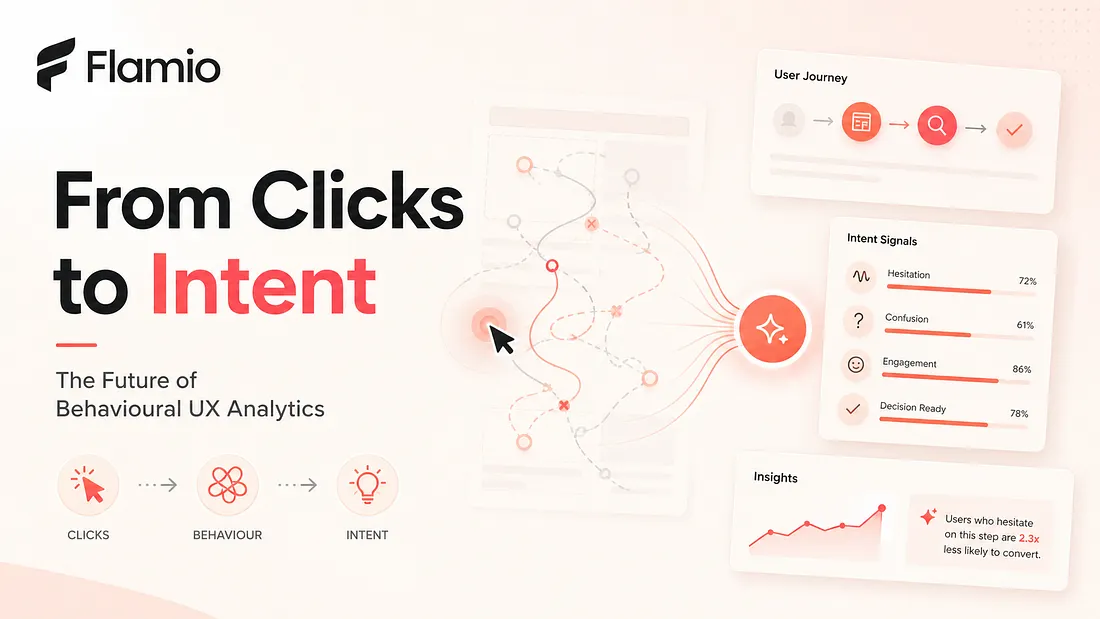
For years, product teams have treated user behaviour as something that can be measured through visible actions. A click, a scroll, a page view, a completed step, an abandoned form. These signals became the foundation of product analytics because they were easy to collect, easy to count and easy to turn into charts. But there is a problem with this way of thinking. A click does not always mean interest. A scroll does not always mean engagement. A long session does not always mean value. A user who abandons a flow is not always rejecting the product. Sometimes they are confused. Sometimes they are unsure. Sometimes they want to continue, but the interface makes the next step feel unclear, risky or unnecessarily difficult. This is where behavioural UX analytics is starting to change. The future of UX is not only about counting what users do. It is about understanding what their behaviour suggests. It is about moving from raw events to user intent, from isolated actions to patterns, from dashboards to interpretation.
Why clicks are not enough anymore
Clicks are useful, but they are limited. They show that something happened, not what the user was trying to do. A user might click the same button several times because the interface is slow to respond. Another user might click a non-clickable element because it looks interactive. Someone else might move back and forth between two steps because the page does not explain what will happen next. In a traditional product analytics setup, these behaviours may appear as simple events. The dashboard may show repeated clicks, a longer time on page or a drop-off at a certain point in the funnel. That information is valuable, but it is incomplete. The team still has to answer the harder questions. Why did users hesitate? What caused the confusion? Was the problem in the copy, the layout, the visual hierarchy, the interaction pattern or the product promise itself? Did the user lose trust, miss the call to action or simply not understand what was expected? Product analytics can show the location of a problem. Behavioural UX analytics should help explain the reason behind it.
The gap between behaviour and intent
Most digital products are full of hidden friction. The problem is that users rarely describe this friction directly. They do not always write feedback saying, "I almost understood the pricing page, but the comparison table made me unsure." They do not open a support chat to explain that the signup form felt longer than expected. They do not tell the product team that the onboarding flow created too much cognitive load in the first two minutes. Instead, they behave. They pause. They hover. They go back. They reread. They click the wrong thing. They abandon the page. They come back later and leave again. These micro-signals are easy to overlook when a team only looks at high-level metrics. This is why user behaviour analysis is becoming more important. It gives product teams a way to understand not only whether a flow works, but how users experience it while moving through it. The real value is not in the event itself. The real value is in the meaning behind the event.
Intent is the missing layer in UX insights
A product team can have thousands of events and still miss the actual problem. Imagine a signup flow where 40 percent of users drop off on the second step. A dashboard can show the drop-off rate. A funnel can show where it happens. A session recording can show what the user did before leaving. But even with all of that, the team may still be left with a vague conclusion: something is wrong here. Intent adds the missing layer. If users repeatedly return to the previous step, they may be checking information they did not fully understand. If they pause before submitting a form, they may be unsure about what data is required or how it will be used. If they click on text, icons or cards that do nothing, the interface may be creating false expectations. If they move quickly through the first steps and then suddenly slow down, the flow may be introducing friction too late. These patterns are not just data points. They are behavioural evidence. Good UX insights should help teams see the difference between a user who is uninterested and a user who is blocked. That distinction matters because the solution is completely different. If users are uninterested, the product may need stronger value communication. If users are blocked, the product may need clearer structure, better guidance or fewer steps. Without interpretation, both problems can look like the same drop-off metric.
The future of product analytics is interpretation
Product analytics has always been strongest at measurement. It helps teams understand what is happening at scale. It shows conversion rates, retention patterns, feature usage and funnel performance. These metrics are still important and will not disappear. But the next layer of product analytics will be more interpretive. Teams will not only ask, "How many users clicked this?" They will ask, "What did this pattern suggest about their intent?" They will not only ask, "Where did users drop off?" They will ask, "What kind of friction appeared before the drop-off?" They will not only ask, "Which feature is used most often?" They will ask, "Do users understand why this feature matters?" This shift is especially important for product teams that need to move quickly. Startups, SaaS teams and growth teams cannot always wait for long research cycles to understand obvious friction. They need faster ways to connect behaviour with decisions. The future of UX insights will come from combining quantitative signals with behavioural interpretation. Clicks, scrolls and drop-offs will still matter, but they will become inputs rather than conclusions.
What better behavioural UX analytics should reveal
A stronger behavioural UX analytics layer should help product teams understand several things at once. It should reveal where users hesitate, not just where they leave. It should identify moments of confusion before they become conversion problems. It should detect repeated patterns that suggest weak information architecture, unclear calls to action or unnecessary cognitive effort. It should help teams understand whether users are moving through a flow with confidence or simply trying to survive it. This matters because many UX problems appear before the final failure. A user rarely drops off without warning. There are usually signs first. A confusing label. An unexpected step. A form field that feels too personal. A button that does not match the user mental model. A page that asks for commitment before it creates enough trust. When product teams can see those signals earlier, they can improve the flow before the metric gets worse. This is the real promise of behavioural UX analytics. Not more charts. Not more recordings sitting unwatched. Not more dashboards that require teams to guess what happened. The promise is clearer interpretation of human behaviour inside digital products.
From observing users to understanding them
Traditional UX research often depends on observation. Watch what users do, listen to what they say, identify the problems and turn those findings into product decisions. That process is valuable, but it can be slow. It also depends heavily on the team ability to notice patterns manually. In a fast-moving product environment, many teams do not have enough time to review every session, compare every behaviour and extract every insight. This creates a strange situation. Teams collect more behavioural data than ever, but they often understand less than they should. The next generation of UX tools will need to reduce this gap. They should not only store behaviour. They should help interpret it. They should make it easier to move from observation to understanding, from watching to deciding. That does not mean replacing designers, researchers or product managers. It means removing the repetitive work that keeps them away from better decisions. Human judgment still matters, especially when it comes to strategy, positioning, ethics and product direction. But teams should not have to manually dig through every behaviour signal just to discover that users are confused by the same step again and again.
Why this shift changes product design
When behavioural UX analytics becomes more intent-driven, product design also changes. Design decisions become less dependent on opinions and more connected to evidence. Teams can stop debating whether a screen "feels clear" and start looking at how users actually move through it. Designers can defend recommendations with behavioural patterns instead of personal preference. Product managers can prioritize fixes based on friction, not only conversion impact. This also makes iteration faster. If a team understands why users hesitate, it can test a more focused solution. Instead of redesigning an entire onboarding flow, the team might only need to clarify one step, reduce one decision, rewrite one explanation or move one action closer to the user goal. The best UX improvements are often not dramatic redesigns. They are precise changes based on a real understanding of where the user lost confidence. That is why user intent matters. It gives teams a better target.
Why Flamio belongs in the intent layer
The core problem is simple: product teams have more behaviour data than ever, but raw behaviour is not the same as understanding. Clicks, recordings and events can show movement, but they do not automatically explain hesitation, confusion, friction or intent. Teams still need to interpret what happened and decide what to improve next. That interpretation layer is where a lot of time gets lost. Flamio is built around this exact shift. Instead of treating user behaviour as a pile of raw signals, Flamio turns behaviour into interpreted UX insight. It helps teams move from "what users did" to "what this behaviour means," making it easier to identify friction, understand patterns and improve product flows before activation or conversion falls apart. This makes Flamio especially relevant for teams that do not just want another analytics dashboard. They want clearer answers. They want to understand where users hesitate, why the experience feels broken and what should be improved next. The future of behavioural UX analytics will not be defined by who counts the most clicks. It will be defined by who helps product teams understand people better. That is the direction Flamio is built for: turning raw behaviour into actionable UX insight, and helping digital interfaces move closer to real human understanding.
Takeaway
The future of behavioural UX analytics is not counting more clicks. It is interpreting behaviour so teams can understand intent, friction, and what to improve next.
More Flamio notes
The End of Watching Session Replays by Hand
Session replay gave teams visibility, but the next product advantage is finding the moments that deserve attention without watching hours of playback.
AI insightsThe Best AI UX Research Will Start With Behaviour, Not Prompts
AI UX research becomes more useful when it starts from real user behavior, intended journeys, and friction patterns rather than isolated interface prompts.
Founder notesBefore You Hire a UX Researcher, Test One Flow
Early teams can learn a surprising amount by testing one critical flow before building a large research process or hiring a dedicated researcher.