

AI Won't Replace UX Researchers. It Will Remove the Work That Slows Them Down
AI is most useful in UX research when it reduces repetitive review and synthesis work, giving researchers more time for judgement and strategy.
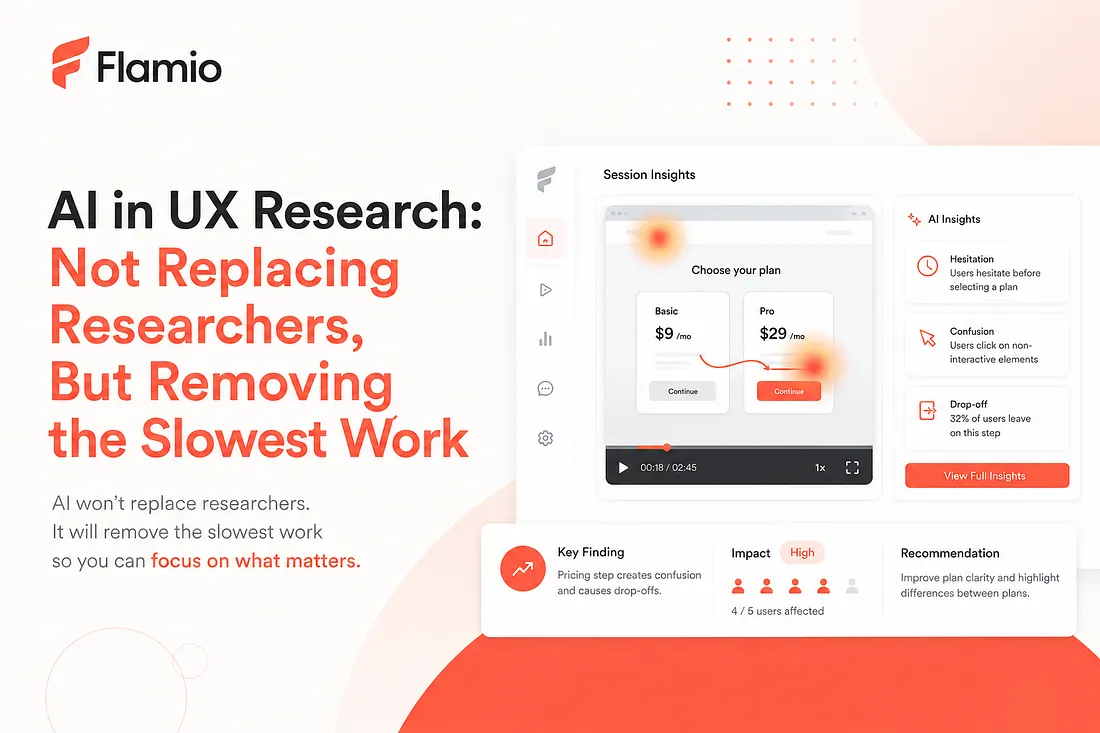
Most conversations about AI UX research start in the wrong place. They ask whether AI will replace UX researchers, as if research were mainly about watching screens, tagging moments, and counting how many users failed to complete a task. That is a narrow view of the work. It mistakes the visible part of research for the valuable part. A lot of UX research does involve labor. Slow labor. Repetitive labor. Watching session recordings. Rewatching the same onboarding flow. Looking for patterns across clicks, hesitations, dead ends, rage clicks, repeated attempts, and drop-offs. Turning scattered behaviour into something a product team can actually use. That part will change. But the better way to say it is not "AI will replace UX researchers." It is this: AI will remove a large amount of the manual work that has been sitting around UX research for years. And that may make good researchers more valuable, not less.
The real bottleneck is not data
Most product teams are not suffering from a complete lack of user data anymore. They have analytics. They have funnels. They have heatmaps. They have recordings. They have dashboards that can tell them where users clicked, where users dropped, and which page performed worse than expected. Still, the same question remains unanswered in far too many product meetings: why? Why did users hesitate before clicking "Continue"? Why did they open the pricing page and leave? Why did they ignore a feature the team spent two months building? Why did they click the wrong element three times before giving up? Traditional analytics gives teams a map of what happened. Usability research tries to explain what the behaviour means. The problem is that explanation takes time. A researcher, designer, or PM has to review recordings, make notes, find patterns, separate noise from signal, and translate observations into decisions. In a large research team, this is painful but manageable. In a startup, it often means the work simply does not happen. A founder may know they should watch ten onboarding sessions. A product designer may know there is insight hidden inside recordings. A PM may know the activation drop is not just a number. But if the choice is between reviewing sessions for three hours or shipping the next urgent fix, research loses. Not because the team does not care. Because the workflow is too heavy. This is exactly where AI belongs.
AI is good at the first layer of interpretation
The first layer of user behaviour analysis is pattern recognition. Did the user stop moving for a long time? Did they scroll back and forth? Did they click something that was not clickable? Did they repeat the same action? Did they abandon the flow after a confusing step? Did several users struggle at the same point? These are the kinds of signals AI can help detect faster than a human starting from zero. It can process many sessions, highlight suspicious moments, group similar behaviours, and create a first version of the insight map. That does not mean it understands the product the way a researcher does. AI can notice that users hesitate on a checkout step. A researcher still needs to ask whether the hesitation is caused by unclear copy, missing trust signals, surprise cost, confusing layout, slow performance, or anxiety about the purchase itself. AI can detect that users click the wrong button. A researcher still needs to understand whether the visual hierarchy is misleading, whether the user came with a different mental model, or whether the task itself was poorly framed. AI can summarize patterns. A researcher has to decide what matters. This distinction is important. UX research is not just observation. It is judgment under uncertainty. It is the ability to connect behaviour to context, intent, constraints, and product strategy. The output of research is not a list of user mistakes. It is a clearer decision.
The workflow changes before the job changes
The biggest shift for UX researchers will be in the shape of the workflow. In the old workflow, a lot of energy goes into collection and review. Set up the test. Record the sessions. Watch them. Tag moments. Pull quotes. Build a report. Present findings. Hope the team acts on them before the next roadmap discussion takes over. In the AI-assisted workflow, more of the researcher's effort moves upstream and downstream. Upstream, the researcher has to define better questions. What are we trying to learn? What is the intended user journey? Which behaviour would count as friction? Which deviations are acceptable alternatives? Which users are we studying, and why? This framing becomes more important, not less. AI analysis is only useful when it is pointed at the right problem. Downstream, the researcher has to interpret the AI output. Which flagged issues are real? Which are false positives? Which patterns matter for this segment? Which issues are severe enough to prioritize? Which recommendation fits the product, brand, business model, and technical constraints? This is where UX researchers can stop being treated as people who validate designs and start acting more like product sense-makers. They are not just reporting what users did. They are helping teams understand what the behaviour means.
The risk is confusing automation with understanding
There is a real danger in AI UX research: teams may accept the first AI-generated answer because it feels clean. A friction score looks objective. A summary sounds confident. A recommendation appears ready to ship. But user behaviour is messy. People hesitate for different reasons. They click wrong elements because of layout, habit, language, expectation, distraction, or because the task is artificial. AI can easily over-detect visible friction and under-detect invisible confusion. For example, a user may complete a flow quickly but misunderstand the value proposition. No rage click. No drop-off. No obvious failure. But the product still failed to create understanding. A good researcher catches this by listening, probing, comparing behaviour with stated intent, and noticing the gap between task completion and actual comprehension. That is why AI should be treated as an analysis layer, not the final authority. It can reduce the cost of getting to the first draft of insight. It should not be the final judge of what users need.
Flamio as an example of where this is going
This is the part of the market that makes Flamio interesting. Flamio is not trying to be another analytics dashboard, session replay tool, or UX testing platform with AI added on top. Its positioning is closer to an intelligence layer between digital interfaces and human behaviour. The useful idea is simple: product teams already have behaviour. What they need is faster interpretation. In Flamio Vision, the workflow starts with the Happy Path, the intended user journey for a flow such as onboarding, checkout, search, or another product task. Instead of only recording what users do, the system compares real behaviour against the journey the team expected users to follow. That comparison matters. A random click is not always a problem. A user taking a different path is not always friction. Sometimes users are exploring. Sometimes they are finding a valid shortcut. Sometimes the intended journey itself is wrong. By analyzing behaviour in relation to the Happy Path, Flamio tries to separate meaningful friction from raw activity. Its materials describe behavioural signals like clicks, scrolls, hesitations, dead clicks, and navigation changes, combined with semantic task context. The output is not just another recording to watch, but structured UX insights: friction points, severity, affected users, root causes, and recommendations. That is the kind of workflow shift AI can bring to usability research. The researcher still matters. A lot. Someone still has to define the Happy Path. Someone still has to know whether the intended flow is actually the right flow. Someone still has to look at a recommendation and decide whether it is good product thinking or just a plausible suggestion. Someone still has to connect the insight to roadmap priorities, design tradeoffs, user segments, and business goals. Flamio's role, in this framing, is not to replace that judgment. It is to remove the slowest part of reaching it. Instead of asking a UX researcher to manually watch every session before the team can see the shape of the problem, an AI layer can produce a structured first pass. The researcher can then spend more time on the part humans are best at: interpreting meaning, challenging assumptions, and helping the team make a better decision. That is a much healthier direction for AI UX research than pretending research can be fully automated.
The future researcher will spend less time watching and more time thinking
The role of UX researchers will not disappear because a tool can summarize recordings. But the expectations around research will change. Product teams will expect faster learning loops. Founders will expect early evidence without hiring a full research team. Designers will expect behaviour-backed recommendations without losing days to manual review. PMs will expect more than dashboards that tell them where users dropped. This creates pressure, but also opportunity. The researchers who thrive will not be the ones who defend every old workflow as sacred. They will be the ones who understand which parts of research are craft and which parts are labor. Watching recordings is often necessary, but it is not the highest expression of the craft. Tagging every hesitation manually is not the core value. Copying observations into a spreadsheet is not why research matters. The value is in knowing what to study, seeing what others miss, understanding the gap between what users do and what teams assume, and turning that understanding into better product decisions. AI will change UX research by making the mechanical parts cheaper, faster, and more available. That does not make human judgment obsolete. It makes judgment the center of the job. The best product teams will not be the ones with the most AI-generated reports. They will be the ones that use AI to get to evidence faster, then use human thinking to decide what the evidence actually means. AI will not replace UX researchers. It will replace the empty hours around the work. And for researchers, designers, founders, and product teams, that may be the real breakthrough.
Takeaway
AI will not replace UX researchers. It will remove the empty hours around the work, making human judgement more central, not less.
More Flamio notes
The End of Watching Session Replays by Hand
Session replay gave teams visibility, but the next product advantage is finding the moments that deserve attention without watching hours of playback.
AI insightsThe Best AI UX Research Will Start With Behaviour, Not Prompts
AI UX research becomes more useful when it starts from real user behavior, intended journeys, and friction patterns rather than isolated interface prompts.
Founder notesBefore You Hire a UX Researcher, Test One Flow
Early teams can learn a surprising amount by testing one critical flow before building a large research process or hiring a dedicated researcher.