

AI in UX Research: not replacing researchers, but removing the slowest work
AI in UX research is not about replacing human judgment. It is about removing the slowest manual work so teams can learn from user behaviour faster.
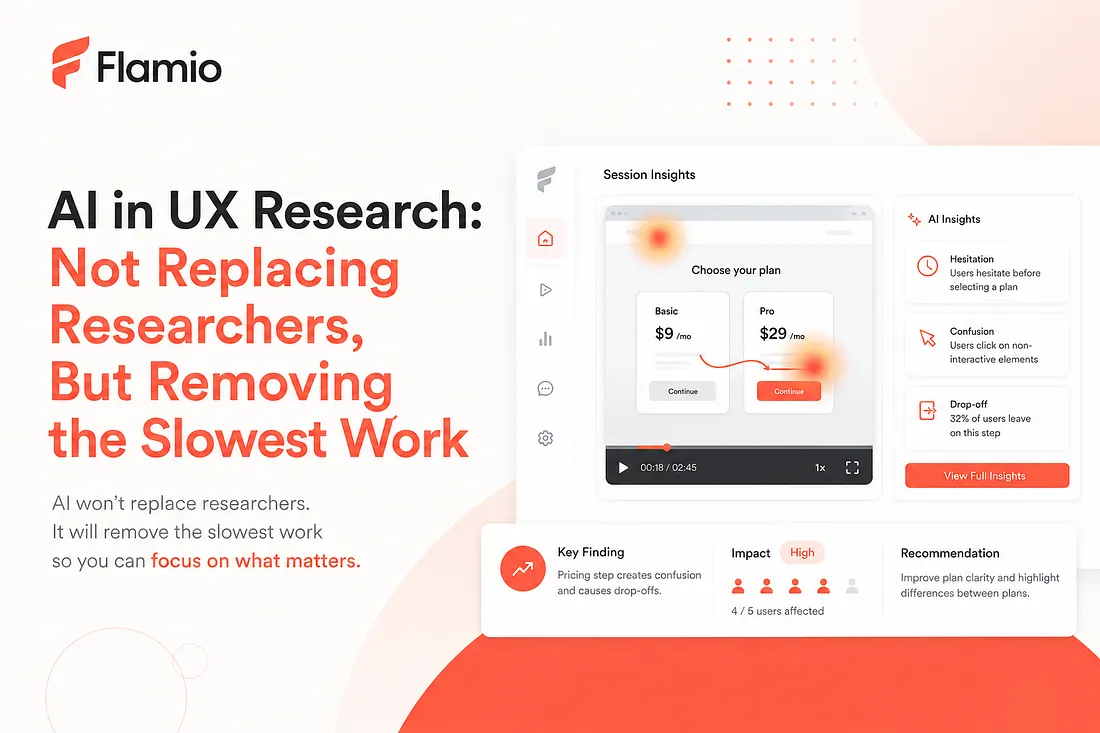
For years, UX research has been treated as something that requires time, patience, and a lot of manual review. Teams run usability tests, record user sessions, collect feedback, and then spend hours watching people move through a product. They pause videos, write notes, compare patterns, look for hesitation, and try to understand where the experience breaks. That work matters. It is often where the real truth appears. But it is also painfully slow. This is where the conversation around AI UX research needs to become more realistic. AI is not replacing researchers. It is not replacing judgment, context, empathy, or the ability to ask better questions. What it can replace is the slowest layer of product research: reviewing recordings, finding repeated behavioural patterns, organizing raw observations, and turning scattered signals into something the team can act on. The future of UX research is not "AI instead of researchers." It is researchers, designers, and product teams using AI to remove the work that slows learning down.
The problem with traditional UX Research is not the research itself
UX research is valuable because it explains what analytics alone cannot. A dashboard may show that users dropped off during onboarding. It may show that a button is rarely clicked, a form is abandoned, or a feature is ignored. But it usually does not explain why. That explanation often lives inside behaviour. A user pauses before choosing a plan. Another clicks something that is not interactive. Someone scrolls back and forth before continuing. A few users open the same dropdown twice, hesitate, and then leave. These small actions are not random. They are behavioural clues. The problem is that finding them takes time. A researcher or product designer may need to watch dozens of recordings before a pattern becomes clear. They need to separate one-off mistakes from repeated friction. They need to decide whether a user was confused, distracted, blocked, or simply uninterested. They need to turn messy observation into a clear product recommendation. That process is important, but a lot of it is repetitive. And repetitive work is exactly where AI in product design can be useful.
AI is best at the work humans should not have to repeat
Good research is not just watching recordings. It is asking the right questions, interpreting context, understanding business goals, and knowing what matters for the product. AI does not remove that need. In fact, it makes human judgment more important. What AI can do is reduce the manual effort around the first layer of analysis. Instead of a researcher watching every second of every session, AI can scan recordings, detect moments of friction, group similar behaviours, and highlight where users seem to struggle. This changes the research workflow. The researcher no longer starts from an empty page. They start from a structured map of possible issues. The product designer no longer has to rely only on instinct or scattered notes. They can review patterns faster and focus on deciding what those patterns mean. That distinction matters. AI should not be treated as the final decision-maker. It should be treated as a research assistant that helps teams get to the meaningful part faster.
The slowest part of usability testing is usually the review
Usability testing AI becomes especially useful when teams need to analyze specific flows. A startup may want to test a signup process. A product team may want to understand why users do not activate after onboarding. A designer may want to check whether a new dashboard layout is actually clear. In all these cases, the test itself can be short. The hard part comes afterward. Watching session recordings is useful, but it is also easy to postpone. Product teams are busy. Designers are moving between tasks. Founders are trying to make decisions quickly. As a result, many recordings sit untouched. The team technically has research data, but no one has time to turn it into insight. This is one of the biggest hidden problems in UX research. The issue is not a lack of data. The issue is a lack of interpretation. AI can help by identifying repeated moments of hesitation, confusion, dead clicks, rage clicks, abandoned steps, and unclear interactions. It can surface patterns that would otherwise stay buried in recordings. It can help teams move from "we should review those sessions someday" to "here are the main issues users faced." That is a huge shift for product research.
AI can make research more continuous
Many teams still treat UX research as a special event. They run research before a big redesign, after a failed launch, or when conversion drops badly enough to become painful. But product behaviour changes constantly. New users arrive with different expectations. Features evolve. Messaging changes. Competitors shape habits. What felt clear three months ago may become confusing today. This is why UX automation matters. The goal is not to automate empathy. The goal is to make learning continuous. When AI handles more of the repetitive analysis, teams can run smaller tests more often. They can validate flows before launch, compare iterations, and spot friction earlier. Instead of saving research for major product decisions, teams can use it as part of everyday product development. That is especially important for startups and small teams. They usually do not have large research departments. They cannot spend weeks analyzing every flow. But they still need to understand users. They still need evidence. They still need to make better product decisions before problems become expensive. AI makes that kind of research more accessible.
The researcher role becomes more strategic
The fear around AI in UX research often comes from a misunderstanding of what researchers actually do. Research is not just collecting observations. It is deciding what to study, choosing the right method, understanding user context, questioning assumptions, and translating findings into product direction. AI does not replace those responsibilities. If anything, AI removes enough manual work to make the researcher role more strategic. Instead of spending hours searching for patterns inside recordings, researchers can spend more time framing better questions, validating findings, challenging conclusions, and helping teams understand what to do next. The same applies to product designers. AI in product design is not about letting a machine decide the interface. It is about giving designers stronger evidence. A designer can see where users hesitate, which parts of a flow create uncertainty, and which decisions cause unnecessary effort. That evidence helps them move beyond personal preference and into behaviour-backed design. Better research does not make design less human. It makes design less random.
The risk is blind trust, not AI itself
Of course, AI can be misused. If teams treat AI-generated insights as unquestionable truth, they will make bad decisions. A model may detect hesitation, but a human still needs to understand why that hesitation happened. Maybe the user was confused. Maybe they were reading carefully. Maybe they were comparing options. Maybe the flow was fine, but the user had a different goal. AI can point to a signal. It should not automatically define the meaning of that signal. This is why the best future for AI UX research is collaborative. AI handles the first pass. Humans make the judgment. AI organizes raw behaviour. Researchers interpret the context. AI highlights possible friction. Product teams decide what deserves action. The value is not in replacing thinking. The value is in reducing the time it takes to reach thinking.
Why this matters for product teams
Product teams often move faster than their research process allows. They launch features, update flows, change onboarding, rewrite copy, and adjust pricing pages. But the feedback loop is usually delayed. By the time the team understands what users struggled with, the product has already moved on. That delay creates bad decisions. Teams rely on assumptions because research takes too long. They prioritize based on opinions because recordings are too time-consuming to review. They keep friction in the product because no one has turned user behaviour into clear evidence. AI can shorten that loop. When recordings become easier to analyze, research becomes easier to run. When patterns are easier to find, decisions become easier to defend. When user friction becomes visible earlier, teams can fix problems before they damage activation, conversion, or retention. This is the practical promise of AI in UX research.
Making user research easier to act on
The core problem is simple: product teams already have more behavioural data than they can properly analyze. Recordings, clicks, hesitation, and friction signals are valuable, but they often stay raw. Without time for manual review, those signals do not become better product decisions. Flamio is built around this exact gap. Its positioning is not another analytics dashboard, but an AI-powered user understanding system that watches user behaviour, detects friction, and turns recordings into actionable UX insights. The goal is to help teams understand what went wrong, why it matters, and what should be improved next. This is also why Flamio broader vision is focused on the layer between digital interfaces and human behaviour. The product direction is based on a simple idea: interfaces should not only display information, they should become better at understanding hesitation, confusion, friction, cognitive overload, and behavioural patterns. AI will not replace UX researchers, product designers, or thoughtful product teams. But it can remove the slowest work that keeps them from learning quickly. It can make usability testing easier to review, product research easier to repeat, and UX decisions easier to connect to real behaviour. That is where the real value of AI in UX research begins.
Takeaway
AI in UX research is most useful when it removes slow manual review and helps researchers, designers, and product teams reach better judgment faster.
More Flamio notes
The End of Watching Session Replays by Hand
Session replay gave teams visibility, but the next product advantage is finding the moments that deserve attention without watching hours of playback.
AI insightsThe Best AI UX Research Will Start With Behaviour, Not Prompts
AI UX research becomes more useful when it starts from real user behavior, intended journeys, and friction patterns rather than isolated interface prompts.
Founder notesBefore You Hire a UX Researcher, Test One Flow
Early teams can learn a surprising amount by testing one critical flow before building a large research process or hiring a dedicated researcher.