

A Small UX Test Beats a Big Internal Debate
Short user tests help product teams replace opinion loops with real evidence from the people trying to use the product.
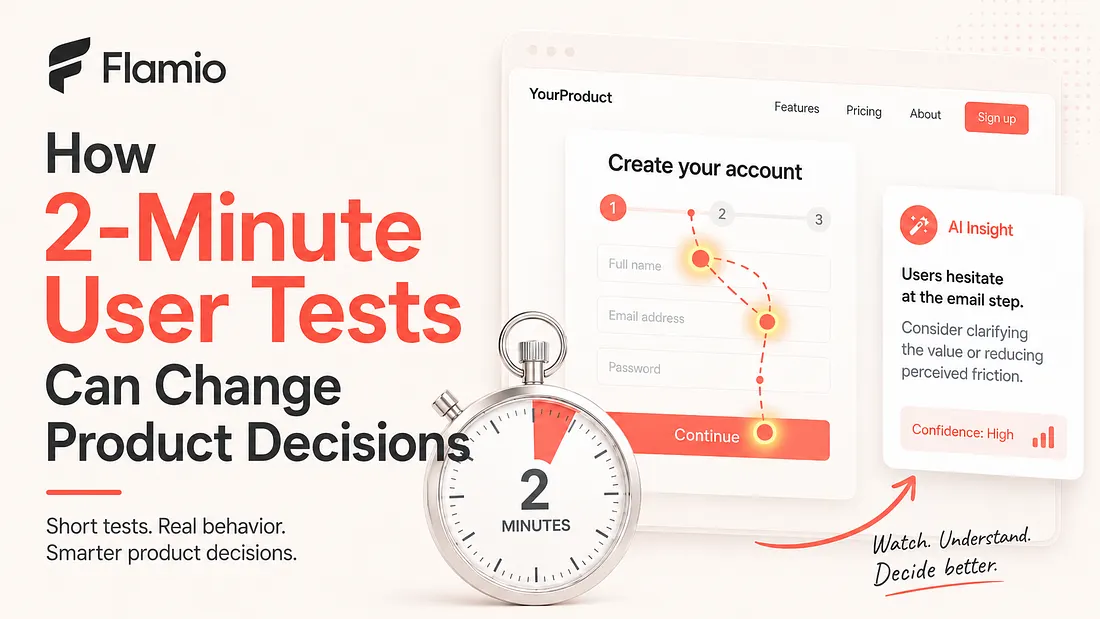
Most product debates do not start as debates. They start as a reasonable question. Should we simplify the onboarding? Should the pricing page lead with features or outcomes? Should this button be higher on the page? Should we remove one step from checkout? Should the dashboard explain itself better? Then the room slowly fills with opinions. The founder thinks users need more context. The designer thinks the interface is already too dense. The product manager wants to protect the roadmap. Sales brings up the last prospect call. Someone references a competitor. Someone else says, "I would never click that." None of this is useless. Internal debate can sharpen thinking. Good teams should argue about product decisions. But there is a point where the conversation stops producing clarity and starts producing confidence theater. Everyone sounds sure. Nobody has watched the user. That is where a small UX test becomes more useful than another hour of internal discussion.
The problem with debating from inside the product
The longer you work on a product, the worse your instincts become in one specific way: you stop seeing the interface as a new user sees it. You know where the button is because you watched it move through three design iterations. You know what the label means because you helped name the feature. You understand the flow because the flow exists in your head before it exists on the screen. Users do not have that luxury. They arrive with a goal, a bit of context, and a limited amount of patience. They do not care how much debate went into the page. They care whether the next step makes sense. This is why internal product debates often become detached from the real question. Teams ask, "Which version do we prefer?" when they should be asking, "What does a user actually do when they meet this flow cold?" Those are very different questions. Preference produces arguments. Behaviour produces evidence.
Small tests reduce the cost of being wrong
A usability test does not need to be a large research project every time. Not every decision requires a formal study, a polished script, and a long report. Sometimes the most useful thing a team can do is test one flow with a few people and watch where reality disagrees with intention. Take a startup onboarding flow. The team believes the journey is simple: a user lands on the welcome screen, chooses a workspace type, connects one integration, invites a teammate, and reaches the first moment of value. Inside the team, this feels obvious. In a small behavioural test, the story may look different. Two users pause on the workspace question because the options sound too similar. One user skips the integration because the button looks secondary. Another clicks the logo expecting to go back. Someone reaches the final screen but still does not understand what changed. Nothing here is dramatic. There may be no crash, no obvious rage click, no angry feedback. But the evidence is enough to change the conversation. Instead of "I think the integration step is fine," the team can say, "Users are treating the integration as optional, but our intended journey depends on it." That sentence is far more useful. It turns a debate into a product decision.
Behavioural evidence is not the same as more data
Many teams already have analytics. They know where users drop off. They can see conversion rates, traffic, events, and funnels. The problem is that these tools often show the shape of the issue without explaining the experience behind it. A funnel can tell you that users leave between step two and step three. It cannot always tell you whether they were confused, unconvinced, distracted, overloaded, or simply unable to find the next action. This is where UX researchers and product teams add value. They interpret behaviour. They notice hesitation. They connect small interface moments to larger product risk. They understand that a drop-off is often the final symptom, not the cause. That is the gap where small UX testing becomes powerful. Not because it gives teams infinite certainty. It does something better. It gives them enough behavioural evidence to stop guessing.
The best test is often the narrowest one
Teams sometimes avoid UX testing because they imagine it as a heavy process. They think they need to test the whole product. Usually, they do not. A better starting point is one important flow with one clear intended journey. Onboarding. Checkout. Search. Demo booking. Account setup. First project creation. Upgrade flow. Anything where user confusion has a real business cost. The narrowness matters. When you test everything, every observation competes for attention. When you test one flow, every behaviour has context. You know what the user was supposed to do. You know where the journey was meant to go. You can compare intention against reality. That comparison is the part most internal debates are missing. A team does not need to ask whether a screen is good in the abstract. It can ask a sharper question: did this screen help the user continue the intended journey? If yes, keep moving. If no, fix the friction.
Where Flamio fits into this
This is where Flamio's approach becomes relevant to the way product teams actually make decisions. Flamio is not trying to be another analytics dashboard, UX testing tool, or session replay platform. Its core positioning is different: Flamio is building an intelligence layer between digital interfaces and human behaviour. The broader idea is simple but important. Interfaces should not only display information. Over time, they should become better at understanding user intent, hesitation, confusion, friction, and behavioural patterns. That matters because the problem is rarely a lack of data. Most teams can already collect clicks, sessions, funnels, and recordings. The harder part is turning that behaviour into something the team can act on. In the context of a small UX test, Flamio helps a team focus on one flow, define the Happy Path, and compare real user behaviour against the intended journey. A team might test onboarding, checkout, search, setup, or another product task. Flamio Vision is built around this intended journey, then analyzes what users actually do across behavioural signals like clicks, scrolls, hesitations, dead clicks, and navigation changes, while also considering the context of the task itself. That is useful because product teams rarely need another folder of recordings that nobody has time to review. They need the moment of decision to arrive faster. A small test might show that users hesitate before a setup step, click the wrong element, or abandon the flow at a point the team assumed was obvious. Flamio's role is to turn those observations into structured UX insight: where the friction happened, how severe it appears, why it matters, and what the team should consider improving next. Used this way, AI UX research does not replace the judgement of UX researchers, designers, founders, or PMs. It gives them better material to think with. The team still decides. But the decision starts from behaviour, not opinion.
The strategic value of testing sooner
The biggest benefit of a small UX test is not that it proves everything. It prevents teams from spending too long being confidently wrong. A five-person test will not answer every market question. It will not replace product strategy. It will not tell you what to build for the next year. But it can show whether a user understands the next step, whether the intended path is visible, whether the language matches the task, and whether the team's internal story survives contact with real behaviour. That is often enough. Especially in startups, product decisions compound quickly. A small assumption in onboarding becomes a weak activation rate. A confusing pricing interaction becomes sales friction. A hidden feature becomes a support problem. A vague first-use experience becomes "users just do not get it." By the time the metric moves, the team has already paid for the mistake. Small UX testing brings the learning closer to the decision. It gives product teams a practical rhythm: form a hypothesis, test one flow, watch behaviour, adjust the decision. Not every debate needs to be won internally. Some debates should be handed to the user.
Takeaway
A small UX test will not prove everything, but it can stop teams from being confidently wrong. Some debates should be handed to the user.
More Flamio notes
The End of Watching Session Replays by Hand
Session replay gave teams visibility, but the next product advantage is finding the moments that deserve attention without watching hours of playback.
AI insightsThe Best AI UX Research Will Start With Behaviour, Not Prompts
AI UX research becomes more useful when it starts from real user behavior, intended journeys, and friction patterns rather than isolated interface prompts.
Founder notesBefore You Hire a UX Researcher, Test One Flow
Early teams can learn a surprising amount by testing one critical flow before building a large research process or hiring a dedicated researcher.